Pokazywanie postów oznaczonych etykietą reenactment. Pokaż wszystkie posty

czwartek, 15 maja 2014

The Medieval Merchants


So, the new season is opened! The long May weekend we spent with our friends in an educational farm in Osice near Pruszcz Gdański. Nights were cold but fortunately we had enough wool blankets to be warm. There were quite many guests visiting the farm and press, TV, radio...
Our stall (photo made by Klaryssa)
 Of course we took all our stuff to show. My laces, yarns and naalbinding goods, Klaryssa's beautiful pincushions, weaved textiles by Rosamar...
 On Saturday Rosamar presented old techniques of spinning and weaving with short introduction about historical sheep, wool and preparing fleece.
 
The presentation of wool and spinning (photo made by Klaryssa)
Weaving (photo made by Klaryssa)
 We also showed our medieval clothes from the end of 14 and the beginning of 15 century. I could appear myself in my new apron.
 In the evening we treated our guests to some medieval dishes.
 
Medieval dishes (photo made by Klaryssa)


The most funny incident were when some lady was absolutely surprised that we are educated. She expected simply peasants taken off from a plough. 


The beginning of the tournament (photo made by Klaryssa)
 Next weekend we went to the court of Konrad Mazowiecki where a tournament were given in the castle of Czersk near Warsaw. This time we were members of some nomadic tribe called Kipchak, Kuman or Połowcy. 

Our castle stall (photo made by Rosamar)


Klaryssa could wear her beautiful caftan first time. We had also our stall with woolen stuff.
 
Wool, wool and once again wool (photo made by Klaryssa)
 And I were asked to give a short interview for television aobut our reenactment.
 
Me and TV camera (photo made by Klaryssa)
 All in all the event were very nice although there could be more customers in our stall.

środa, 30 kwietnia 2014

The smocked apron for a medieval innkeeper

I wanted to begin new medieval season by a quiet and nice picnic. May be two days picnic. So I persuaded my friend Klaryssa to call our friendly farm if it was possible to pick up our tents there. The landlady was so excited that instead of calm picnic it will be a real fest with invited very important persons, press and gods know who else. I want to serve some medieval dishes and that means spending some time in the kitchen. As an innkeeper I need some apron.
Watching The Luttrell Psalter (an English illuminated psalter written and illustrated c. 1320–1340 by anonymous scribes and artists) I found several smocked aprons I liked.

A poor woman cultivating her field


Some peasant working with sheeps

A woman feeding chickens

A spinner

Harvesting women

I used white linen to create my apron. Firstly I drew lines for chosen pattern, then I made so called honey comb.
The begining of a honey comb

When the honey comb was ready I hemmed it by pale pink Egyptian cotton.
The honey comb is ready
The second line of my pattern it is made of trellis stitch which let me achieve half diamond shape.
A half of diamond shape under the honey comb
Under this part I made a chain using the same pink cotton.

In the end of the pattern I made a honey comb once again.
The whole pattern
Then I added a belt, hemmed the whole apron and there it is, my apron for medieval innkeeper.
My apron in its magnificence
The aprons in The Lutterell Psalter are more decorative. It was black thread used to make the patterns. But I think that one apron it is not enough for me, so next time I will create a black ornament.In the pictures you can also see a wonderful pincushion gifted me by Klaryssa who made it by herself using the pattern of a cushion from XIV century (Victoria & Albert Museum).

poniedziałek, 6 stycznia 2014

Let's be Kipchak!


Last year my friend and ultimate guru in reenactment Rosamar encouraged me to engage in her nomadic project. We started preparing clothes and equipment. The choice was Kipchak tribal confederation.
Kipchak, Cumans, Polovtsy came to our part of Europe in 10th century. Some scientist believe that they were blond and blue-eyed, so I can reenact a woman from this tribe.
They left a lot of remainings and sculptures so we have got quite many materials to reconstruct clothes and equipment. For more informations look here, here and here.
My first 'item' I'd like to show is a caftan. So far I have made two caftans: one for my friend Klaryssa and one for myself. Here they are.

First caftan I’ve ever sewn was mine. I always start doing my things to be sure that I won't spoil things for my clients. The pattern for this caftan contains three panels, gussets on sides, long sleeves also with gussets. Because it is quite short there's no placket at the back.

Carmine Kipchak caftan
 I used carmine wool mixed with silk. For seams I used two kind of threads, both hand spinned: grey Gotland wool and dyed in walnut shells Polish mixed wool. I decided for so called triple stitch as very decorative and useful.
 
Gussets and two colours of seams
The triple stitch
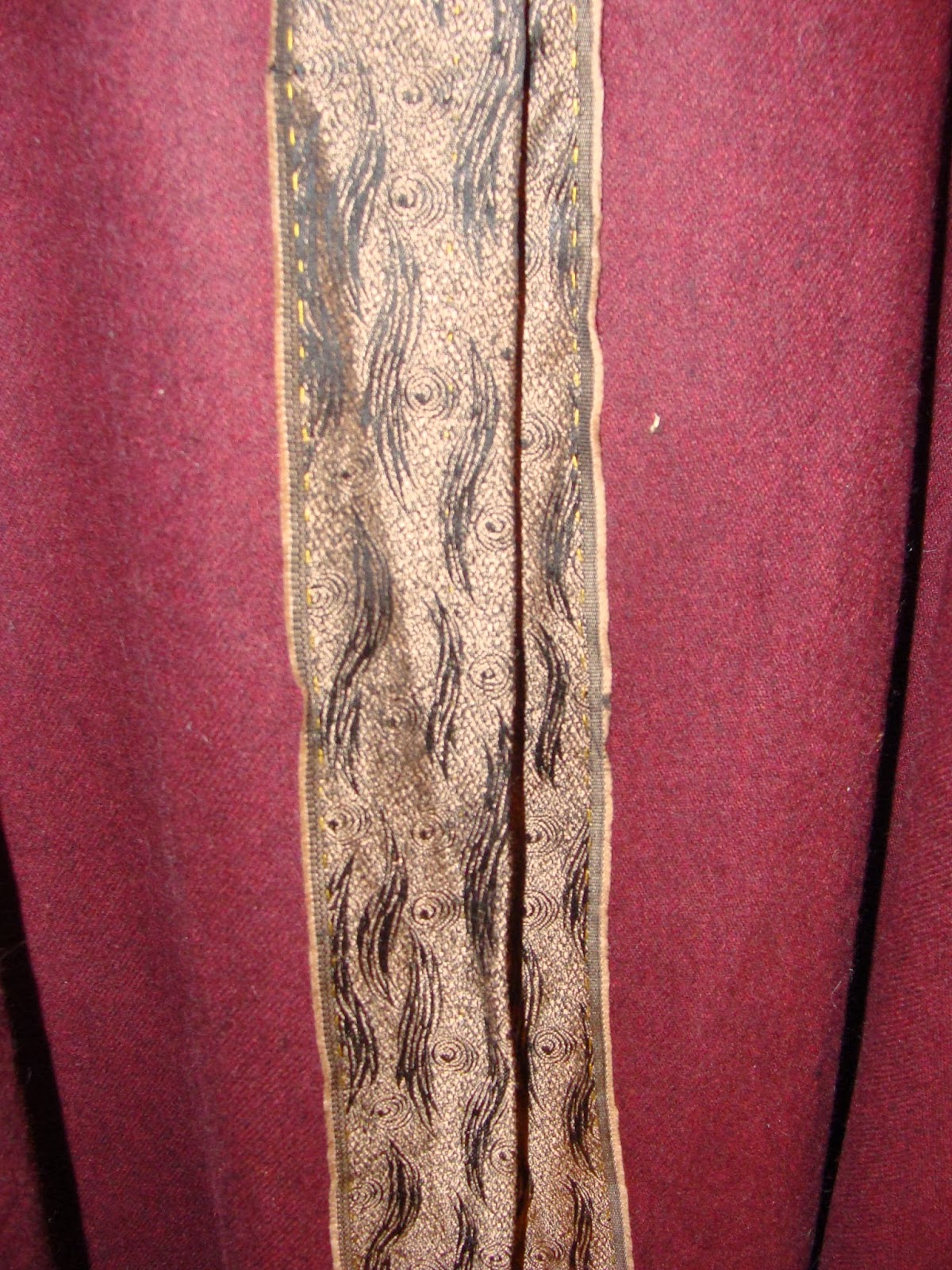
  Then I had to sew hems. I owned an old scarf made of decorated with a pattern silk in black and gold. It seemed perfect for my purpose.
 
Silk hems
I used tin buttons and woollen loops.
 
A button and a loop
First time I wore this caftan last June during reenactment of Battle of Cedynia.
 
During last Christmas I made another caftan. The pattern for this caftan was almost the same as mine, but I resigned from the seams on the shoulder so there were only two long panels. It was also a little longer than mine so I made a placket at the back. This time it was made of pure wool in malachite colour. (All pictures below made by Klaryssa).
The back of Klaryssa's caftan
 For seams I used machine spinned Polish wool in maroon colour (although it seems red in the pictures). Of course also triple stitch.
 
The triple stitch
For hems I decided to use two-tone silk taffeta in blue and ruby pink colours. Unfortunately, it is almost impossible to show this silk in pictures.
 
Embridered hems of Klaryssa's caftan
Because hems were without patterns I embroidered them using quite simply pattern popular on Chinese silk.

For loops I used the same wool as for seams. Buttons are made from brass.
A brass button and a loop
 
Klaryssa's caftan in all it's magnificence

 Of course this is not my last creation in The Kipchak Project!

wtorek, 24 grudnia 2013

The History of One Necklace

A long time ago I saw the portrait of Magdalen Portinari by Hans Memling, 1470.
Magdalen Portinari, Hans Memling, 1470

More I was looking, the more I was convinced I could make this necklace as a lace. (Don't you think it's a word-play? Neck-lace of a lace?)
First try was made of Egyptian cotton-wool with pearls and amber stones.
One of flowers with a pearl and amber stones

One necklace was for ma friend, Klaryssa, second for my sister.

The whole necklace for Klaryssa

But last year another my friend asked me if I could try to make it once again. Of course I agreed, but I changed a little bit. First of all I took the decision to create a bigger one. That was why I knew that I had to use some kind of a jevellery cord not only threads. Rita, who ordered this necklace, gave me quite big pearls and other stones: turquises, corals and much more.

The flower is made by two shuttles. Because I had forgotten how to create them I tried three times. And after several hours all flowers were ready.
During the work of the first flower

All flowers with pearl petals and semi-precious stones centres
Plaitings bettween flowers are made by four shuttles. Unfortunatelly I didn't have enough shuttles that was why I had to unwind threads to pull it through. Believe me, it was an ordeal.
The first part of plaitings
Making the second part of plaitings

But finally the necklace was ready and I was quite glad of the result.
The Portinari Necklace - back details
The Portinari Necklace

I think I will try to make it once again.

niedziela, 8 grudnia 2013

It's cold outside (after Xaver - Sven - Bodil Cyclone)

And there is my answer: warm naalbinding socks (handmade yarn and not) and gloves. Mainly for reenactors, but maybe not only. All of these things were made by mammen stich, which is elastic and close enough for such stuff.

For the beginng very delicate gloves:

Shepherd gloves, naturally brown irish wool, spinned on a spindle.


And some not as delicate as previous ones, but very warm.


Shepherd gloves, naturally beige Persian lamb wool, spinned on a spinning wheel.
And there is a pair of very exclusive socks made of wool dyed by my friend, Rosamar.


Socks, dyed in madder Polish mixed wool and Persian lamb wool, spinned on a spinning wheel.
Las, but not least: two pairs of socks a little bit cheaper because made of not handmade yarn.


Socks, Polish mixed wool, spinned and dyed by machinery.

Socks, Polish mixed wool, spinned and dyed by machinery.